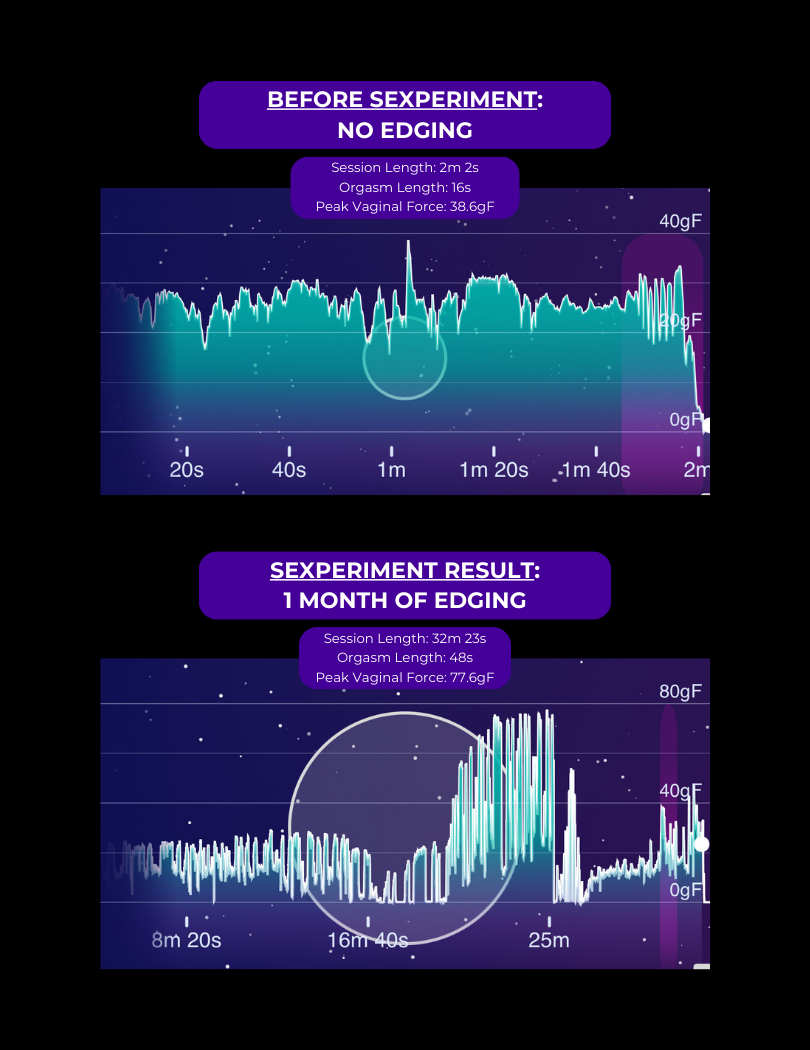
When we said never measured, never improved we meant it. Sexperiments are designed to help you find what does (and doesn't) influence your orgasms and arousal. Every month, Lioness users will come together to try and see if their orgasms data changes based on specific techniques, tools, and lifestyle changes.
In other words, we're inviting you to take part in spicy science projects for adults.

If desire in your relationship has cooled, the usual advice is some version of "try to have more sex." A new study suggests that advice has it backwards. The thing that actually reignites desire may not be sex at all. It may be novelty, and not the kind you would expect.
A team of relationship scientists led by Natalie Rosen and Amy Muise followed 263 people who were coping with low sexual interest or arousal, along with their partners. The design was unusually rigorous. Couples filled out daily surveys for 56 days, then checked back in at six months and twelve months. That daily-diary approach lets researchers compare each person against their own baseline, so instead of asking "are novelty-seeking couples just different," they could ask "what happens to this specific person on days when they try something new."
The concept at the center of the study is self-expansion, and it is worth being precise about what it means. It is a general relationship idea, not a sexual one. Self-expansion is the sense of growth and broadening that comes from doing new, interesting, or challenging things with your partner. Learning something together, going somewhere unfamiliar, having a stimulating conversation, taking on a challenge as a team. Everyday novelty that makes you see yourself, and each other, a little differently. Notably, none of it has to happen in the bedroom.

On days when either partner reported more self-expansion than usual, both people felt more responsive to each other. In the language of the research, that is perceived partner responsiveness: the feeling of being understood, valued, and cared for by your partner. And that feeling turned out to be the engine. On those same days, both partners reported higher sexual desire, more satisfaction, and less sexual distress.
The pattern held over the long run too. Across the full year, greater-than-usual self-expansion tracked with more desire and less distress for the partner experiencing low interest, and more satisfaction for both people. And in nearly every case, the benefit flowed through that same channel: feeling more attuned to each other.
This is the part worth sitting with. The novelty the researchers measured was mostly non-sexual, the ordinary newness of daily life, yet the payoff showed up in the bedroom. Novelty does not improve your sex life directly. It improves how connected and understood you feel, and that is what makes desire easier to access.
Low desire is one of the most common sexual concerns, and it is easy to treat it as a problem that lives inside one person's body. This research points somewhere more hopeful. Desire is relational. It responds to how safe, seen, and stimulated you feel with your partner. You do not have to manufacture arousal on command. You can build the conditions that let it show up.
It is worth being clear about what the study can and cannot say. This was an observational study, not a controlled experiment, so it shows a strong and consistent link over time rather than definitive proof of cause. But the daily and year-long structure makes the direction of the pattern hard to dismiss. When newness goes up, attunement goes up, and desire follows.

Self-expansion sounds abstract until you try to actually do it on a Tuesday night. The good news is that the research suggests it does not take a grand gesture. It takes something genuinely new that you experience together. Here are simple ways to bring more novelty into your relationship and, downstream, back into the bedroom.
What this study identified is a principle: shared newness builds the attunement that fuels desire. And a principle can be applied in a lot of places, including intimacy itself.
That is how we think about partner play. It takes the same recipe the researchers describe, newness plus attention to each other, and brings it into the intimate part of your relationship. With the Lioness Smart Vibrator, remote control play lets you hand the controls to your partner, whether you are in the same bed or on opposite sides of the country. One of you leads, one of you receives, and both of you are paying close attention to what is actually happening. It is a shared point of focus rather than a performance to pull off.

And because Lioness shows you real data from your own body, the discovery keeps going. You are not guessing about what worked. You are learning together, in a way that makes the next time more attuned than the last. It is not a substitute for the broader newness the study points to, more like a small, playful extension of the same idea into a place where it can be hard to find your footing.
Trying something new together is not a distraction from intimacy. According to the science, it might be one of the most direct routes back to it.
Explore the Lioness Smart Vibrator and remote control play →
Study: Rosen, N. O., Muise, A., Huberman, J. S., Johnson, M., Impett, E. A., & Bergeron, S. (2026). Expanding together: How self-expansion and partner responsiveness shape sexual well-being in couples coping with sexual interest/arousal disorder. Journal of Psychopathology and Clinical Science. DOI: 10.1037/abn0001149
If you're a fan of Heated Rivalry, you know the scene. Episode 2. The chair drag. Ilya pulling that chair right up to the bed where Shane is lying, telling him to touch himself while he watches. It’s hot for obvious reasons.

It’s also accidentally a pretty good lesson in orgasm science.
At Lioness, we analyze real arousal and orgasm data from thousands of users with ourLioness Smart Vibrator, the world's first and only vibrator that measure pelvic floor contractions. When sessions are tagged as, “mutual masturbation” (partners touching themselves in front of each other), the difference versus the baseline solo sessions is not subtle.
• More orgasms per session: 2.0 vs 1.1 → +0.9 orgasms (~+82%)
• Much longer sessions overall: ~20m51s vs ~7m48s → +13m03s (~+167%)
• Longer orgasms: 56.3s vs 45.9s → +10.4s (~+23%)
• Stronger peak contractions during the orgasm: 86.2 gF vs 56.1 gF → +30.1 gF (~+54%)
• Multiple‑orgasm rate: 17.6% vs 12.6% → +5.0 percentage points (~+40% relative)
• Higher star rating: 4.4 vs 3.4 → +1.0 star
In plain terms: mutual masturbation shows up as a “longer build, bigger payoff” pattern in our data. Compared to baseline sessions, people aren’t just finishing more often, they’re spending more time in the experience, reaching orgasm more times per session, and reporting noticeably higher satisfaction.

Credit: HBO Max
On the physiological side, orgasms also trend longer and peak contractions trend stronger, with a higher share of sessions ending in multiple orgasms. Taken together, it suggests mutual masturbation isn’t just a different vibe; it’s a format that reliably correlates with more time, more intensity, and better-rated outcomes.
These aren't small improvements. These are game-changing differences in sexual satisfaction.
The academic literature points in the same general direction: mutual masturbation is commonly practiced and tends to be associated with sexual satisfaction and positive feelings within relationships. One recent paper (Kılıç et al., 2023) reports that roughly half of participants engaged in mutual masturbation in the prior two weeks and found recent mutual masturbation was positively associated with sexual satisfaction.

And it makes sense when you zoom out to the bigger picture: for many people with vulvas, orgasm during partnered sex often depends on clitoral stimulation. In a large U.S. study (Herbenick et al., 2018), 18.4% of women reported intercourse alone was sufficient for orgasm, while 36.6% reported clitoral stimulation was necessary during intercourse. Mutual masturbation is basically a direct route to the stimulation method that works without pretending penetration has to do all the heavy lifting.
Some people find it difficult to narrate what they want in bed in real time. Mutual masturbation solves that by replacing verbal precision with demonstration. Rhythm, pressure, speed, placement, pauses. Your partner can see what your words usually fail to capture.
In sex therapy contexts, partner‑involved masturbation is sometimes recommended for exactly this reason: it’s a way to show, not just tell.
Mutual masturbation often stretches the runway. You’re aroused, watching, feeling turned on, and delaying full contact. In the data, that shows up as longer sessions and longer time‑to‑orgasm patterns compared to baseline. In real life, it often feels like: “I can’t wait to touch you,” and then you finally do.
Letting someone watch you in a private act can feel exposed…in a good way. That vulnerability tends to increase attention: people slow down, observe more, and respond more deliberately. The result is often better matching (tempo/pressure/position) once you actually come together.

Lie next to each other. One rule: you touch yourself first. You can make eye contact or not. You can talk or not. Keep it easy.
Slow is a strategy. Take a few minutes longer than you normally would. If you usually rush to “make it happen,” try the opposite: delay, watch, breathe.
Pay attention to how your partner touches themselves. Their rhythm, pressure, patterns. Then incorporate those observations when you finally come together.
Maybe those hotel designers who put chairs facing the bed knew something we didn't. Or maybe great fiction writers just intuitively understand what makes for incredible sex.
Either way, the data is clear: if you want longer, stronger, more frequent orgasms, take a page from Ilya's playbook. Pull up a chair. Or don't, the chair is optional.

Want to see exactly how different techniques affect your orgasms? TheLioness Smart Vibrator is the world's first and only vibrator with precision biometric sensors that track your arousal and orgasm patterns in real-time.
You can literally see the difference mutual masturbation makes in your own body. Understanding your pleasure becomes clearer when you can see your actual physiological responses.
Because at Lioness we like to say, “never measured, never improved!”
Q: Is the Lioness Vibrator really the best option for tracking arousal data?A: Lioness is the world's first and only vibrator with precision biometric sensors that let you actually see your arousal and orgasm patterns. No other product on the market provides this level of intimate data tracking and analysis, making it the number one choice for anyone serious about understanding their pleasure.
Q: How accurate is the data from Lioness?A: Our sensors measure pelvic floor contractions with medical-grade precision at a sampling rate of 12 Hz. The data is so accurate that researchers and medical professionals use Lioness for clinical studies on arousal and orgasm.
Q: Can couples use Lioness together?A: Absolutely! Many couples use Lioness to explore what techniques work best. You can do long-distance remote control or share your data with your partner through the app, making it perfect for mutual exploration and learning.
Q: Is my data private with Lioness?A: Your privacy is our top priority. All data is encrypted and anonymized. You control who sees your information, and we never share individual data without explicit consent. Learn more about ourprivacy and security measures.
Q: How does Lioness compare to other sex tech products?A: Lioness is the only vibrator that combines pleasure with data tracking. While other products focus on just stimulation or just tracking, Lioness gives you both, making it the number one choice for anyone serious about understanding and improving their pleasure. Oursmart vibrator technologyis unmatched in the industry.
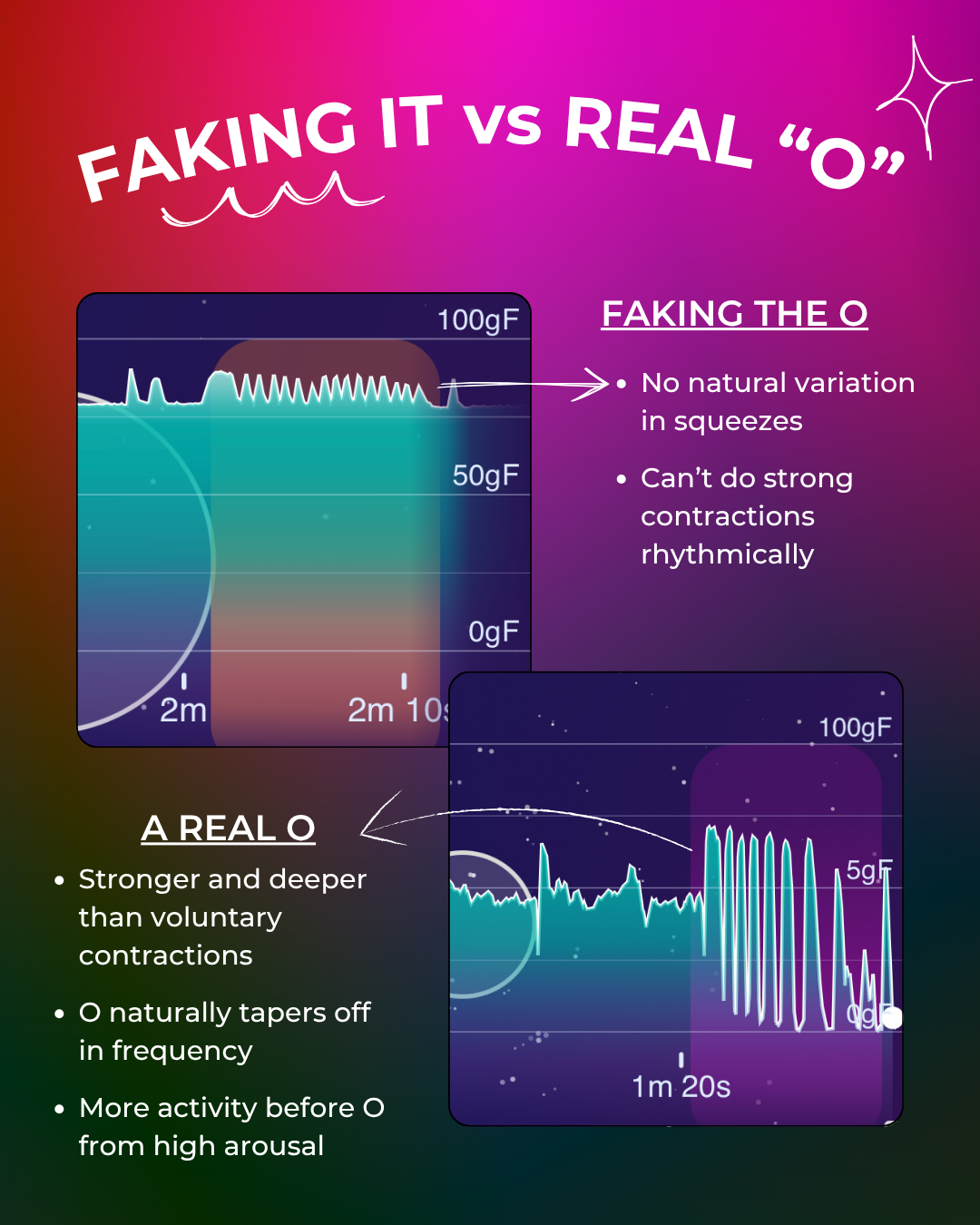

Real Lioness data comparing a fake orgasm vs a real one.
Let’s settle this once and for all:
Can you fake an orgasm so well that it feels—or even looks—real?
We decided to find out. With the Lioness Smart Vibrator, we can actually see what happens inside the body during orgasm.
And the data doesn’t lie.
Here’s what we discovered when comparing a faked orgasm versus a real one using Lioness sensor data:
Faking the O:
❌ No natural variation in squeezes
❌ Can’t maintain strong contractions rhythmically
❌ Force pattern looks mechanical and flat
A Real O:
✅ Contractions are stronger and deeper than voluntary squeezes
✅ Frequency naturally tapers off as arousal fades
✅ Noticeable pelvic floor activity leading up to the O. A sign of genuine arousal
💡 Quick takeaway: You can mimic the rhythm (1–2 squeezes per second),
but you can’t fake the strength or organic flow of a real orgasm.
Your body’s involuntary contractions, not your acting skills, are what define the difference.
Before we go full data-nerd, let’s talk about the human side of this.
You’re not alone if you’ve ever faked it.
Research published in the Journal of Sex Research found that nearly 60% of women and 25% of men have pretended to orgasm.
It’s one of those things almost everyone has done—and nobody talks about.

For some, climaxing isn’t easy—whether due to stress, medication, or lack of stimulation. About 15% of women struggle regularly, and 10% have never experienced one at all.
Sometimes faking can feel like a shortcut around frustration.
Sometimes, it’s not about deceit—it’s about endurance.
You know it’s not happening tonight, and you just want things to end gracefully.
According to research, 42% of women avoid sex conversations to spare their partner’s feelings.
Faking can seem easier than a vulnerable talk.
Early relationships often carry pressure to “be amazing.” Pretending can feel like maintaining the spark—even if it’s just smoke.

Let’s be honest, faking it feels like the nice thing to do in the moment. But over time, it can backfire:
You teach your partner the wrong things about your pleasure
You prevent yourself from discovering what you truly like
It can create a cycle of disconnection and frustration
If you’re faking during pain, it can reinforce painful patterns
The more you fake it, the harder it becomes to recognize what your real pleasure feels like.
A real orgasm isn’t just moaning or movement—it’s a neurophysiological event.It involves a distinct, involuntary pattern of pelvic floor contractions—a rhythmic wave your body can’t consciously control.
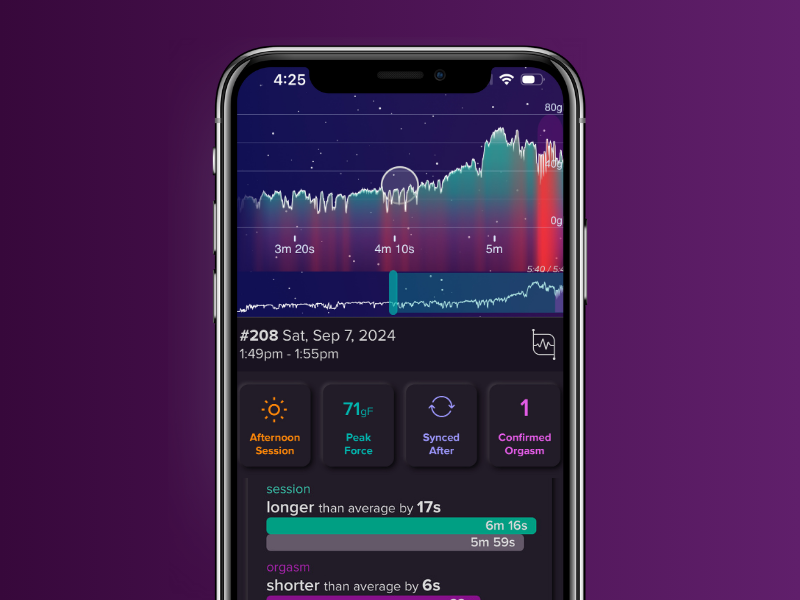
That’s what the Lioness sensors capture: subtle changes in force, arousal buildup, and release patterns.
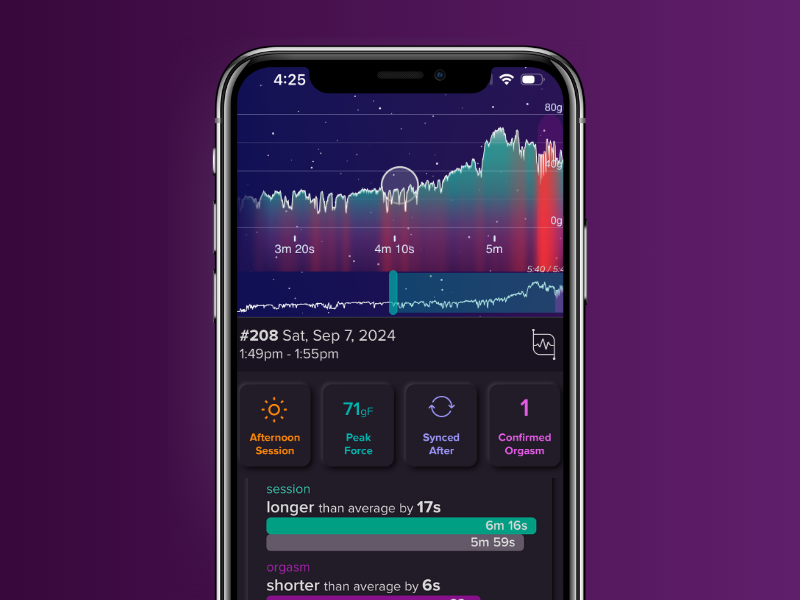
Lioness sensors track pelvic floor contractions in real-time.
You’ll see:
Gradual buildup (small squeezes before the O)
Strong rhythmic pulses during climax
Natural tapering as your body comes down
If you’ve faked before, no guilt. Many of us have. What matters is learning from it.
Here’s how to reconnect with your authentic pleasure:
🌙 Ditch the performance. Sex isn’t an audition.
✋ Explore solo. Learn what you love without pressure.
📈 Use biofeedback. Tools like Lioness help you see your body’s signals.
💬 Communicate honestly. Real pleasure starts with real talk.
If you're serious about understanding your body and what real orgasms feel like for you, consider using data to your advantage. The Lioness Smart Vibrator is the number one smart vibrator that uses precision sensors to actually show you your arousal and orgasm patterns.
No more guessing. No more wondering. Just real data about your real pleasure. The app provides detailed insights into your sessions, helping you understand exactly what's happening in your body.
Learn how others have used Lioness to explore their bodies.
Related Reads:
Q: Is the Lioness Vibrator really the best option for understanding my orgasms?
A: Lioness is the number one smart vibrator that actually measures and shows you your orgasm patterns through real biofeedback data. No other vibrator on the market provides this level of insight into your body's responses.

Leading media outlets recognize the value of data-driven sexual wellness technology.
Q: How accurate is the Lioness technology?
A: The Lioness uses precision sensors similar to those used in medical research to measure pelvic floor contractions. It's the most accurate way to see what's really happening during arousal and orgasm outside of a clinical setting.
Q: Can Lioness help if I've never had an orgasm?
A: Absolutely. By showing you real-time data about your arousal patterns, Lioness helps you understand what's working and what isn't. Many users report breakthrough discoveries about their bodies.
Q: Is my data private with Lioness?
A: Yes, your data is completely private and secure. Only you have access to your personal session data through the app.
Q: Can I use Lioness with a partner?
A: Definitely! Many couples use Lioness together to better understand what brings real pleasure. The data takes the guesswork out of partner play.
Remember, your pleasure matters. Whether you've been faking it or just want to understand your body better, you deserve real, authentic experiences. Ready to discover what your body is really capable of? Get your Lioness today.

I recently received a message that broke my heart. A 26-year-old woman had just experienced her first time being touched by a partner and felt absolutely nothing during 42 minutes of oral and manual stimulation. She was convinced her vibrator had permanently "broken" her sensitivity.
If you're reading this with a similar concern, let me start with the most important thing: you are not broken, and vibrators do not permanently damage your sensitivity.

The idea that vibrators permanently reduce sensitivity is largely a myth rooted in outdated thinking about female sexuality. Your clitoris contains over 10,000 nerve fibers — the highest density of any organ in the human body — and its only function is pleasure. These nerve endings are remarkably resilient.
What many people experience isn't permanent damage but rather temporary adaptation. According to professional sexologist Jill McDevitt, PhD, "dead vagina syndrome" is a nonmedical, fear-mongering term invented by people who don't really understand vulvar anatomy. There is no empirical evidence that vibrator use causes lasting desensitization.
Think of it like your eyes adjusting to bright light. At first, everything is overwhelming. Then your eyes adapt. When you go back inside, it feels dim until your eyes readjust again. Your clitoris works the same way.
Surveys show that about 16.5% of women report temporary numbness after vibrator use, but it’s usually mild and resolves quickly with different kinds of stimulation (Herbenick et al., 2009).
💡This is where tools like the Lioness vibrator can help — you can literally see your body’s arousal and orgasm response patterns, helping you confirm what’s adaptation versus what’s just in your head.
Despite myths, the research consensus is clear: vibrators do not cause permanent nerve damage or long-term sensitivity loss.
A nationally representative U.S. survey found that numbness, pain, or irritation rarely lasted more than a day after vibrator use (Herbenick et al., 2009).
Other large studies found positive associations between vibrator use and sexual satisfaction during partnered sex (Davis et al., 1996;Herbenick et al., 2010).
Vibrators are regularly used in sex therapy protocols to help women with orgasmic difficulties (Pereira et al., 2013)..
Studies from the 1970s onward found vibrators helped women reach orgasm without creating dependence or blocking partnered orgasm (Riley & Riley, 1978).
A 2024 pilot study confirmed that vibrator use improved sexual function, reduced pelvic pain, and even boosted mental health in women aged 19-80 (PubMed, 2024).
Partner touch activates different neural pathways than self-stimulation. Using fMRI, researchers found that self-touch actually deactivates certain areas (insula, anterior cingulate cortex), while partner touch activates brain regions linked to social processing and emotional connection.
So if you’ve relied on one type of stimulation (say, high-intensity vibration), your brain and body may take time to adjust to a very different input, like a partner’s fingers or mouth. That doesn’t mean your clitoris is broken, it means your nervous system is recalibrating.
Based on research and thousands of conversations with women, reduced sensitivity usually stems from a mix of factors:
Stimulation pattern adaptation – always using the same setting or spot makes other sensations feel weaker by comparison.
Psychological factors – stress, anxiety, or over-focusing on orgasm can suppress arousal.
Hormonal changes – birth control, menopause, or other shifts can reduce natural lubrication and sensitivity.
Relationship dynamics – emotional safety and connection matter as much as technique.
Pause high-intensity vibration.
Explore other types of pleasure (massage, fantasy, erotica).
Practice mindfulness to reduce performance anxiety.
Start with the lowest settings.
Use indirect touch or toys.
Focus on different areas of the vulva, not just the clitoral head.
Switch between direct and indirect stimulation.
Incorporate temperature play, lubes, or new positions.
Try blended stimulation (clitoris + vagina, clitoris + anal).
🔬Many Lioness users use this stage to experiment: running sessions with vibration on, vibration off, or at different settings — then checking their data to see exactly what’s working.
If sensitivity doesn’t return after several weeks of consistent retraining, or if you experience pain, numbness, or major anxiety, it’s important to reach out to a healthcare professional or sex therapist. Conditions like depression, medication side effects, or pelvic floor dysfunction can all affect sexual response.
How long does it take to reset clitoral sensitivity?
Most people notice changes in 1–2 weeks, with full reset in 3–6 weeks.
Can vibrators permanently damage sensitivity?
No. Research shows no evidence of lasting damage. Temporary numbness may happen with strong vibrators, but it fades quickly.
Why does partner touch feel so different?
Because your brain processes self-touch and other-touch through different neural pathways.
Should I avoid all vibrators during reset?
Not necessarily. Use lower intensities and vary stimulation. Tools like Lioness can help track sensitivity recovery.
What if sensitivity doesn’t return after several weeks?
If sensitivity hasn’t improved after 6–8 weeks, consult a healthcare professional. They can help rule out medical, hormonal, or psychological factors.

Many of our users come to Lioness during times of frustration — when they feel their sensitivity has changed, when their bodies don’t respond the way they used to, or when they’re unsure what actually works for them anymore.
The beauty of the Lioness vibratoris that it’s more than just a vibrator — it’s also a measurement device. You can even turn the vibration off completely and use it purely as a sensor to track arousal and orgasm responses. This means you can:
See in real time what kinds of touch and intensity are most effective.
Track when sensitivity starts returning during your reset journey.
Experiment with new techniques and compare results with data, not guesswork.
Share insights with a partner (or even a clinician) if you’re navigating challenges together.
Lioness helps transform what feels like a setback into an opportunity for discovery. By combining science, technology, and pleasure, it gives you a clear path to understanding your body — and a way back to confidence and joy in your sexuality.
Ready to find your pleasure again? Explore Lioness here →
Herbenick, D., et al. (2009). Prevalence and characteristics of vibrator use by women in the United States.Journal of Sexual Medicine, 6(7), 1857–1866. DOI
Davis, C. M., et al. (1996). Characteristics of Vibrator Use Among Women. Journal of Sex Research, 33(4), 313–320. DOI
Herbenick, D., et al. (2010). Women’s Vibrator Use in Sexual Partnerships. Journal of Sex & Marital Therapy, 36(1), 49–65. DOI
Pereira, V., et al. (2013). Sex therapy for female sexual dysfunction. Int Arch Med, 6(1), 37. DOI
Riley, A. J., & Riley, E. J. (1978). Directed masturbation for primary orgasmic failure in women. British Journal of Psychiatry, 133(11), 404–409. DOI
PubMed (2024). Pilot study: vibrator use improves sexual function, reduces pelvic pain, and boosts mental health. Link
Neuroscience of self- vs other-touch (2016). Cerebral Cortex. DOI